I am not a researcher, I am a failed implementer. I tried to implement a technology-based learning approach in a Tanzanian school and failed miserably – both in impact and sustainability. Failure is valuable because it gives you a sense of purpose not to repeat the same mistakes.
Part of my ‘reflection’ on that experience was to take the OU Masters in Online and Distance Education – to understand what I did wrong and might do better. That experience highlighted several things:
- The value of interaction via forums and synchronous sessions in developing broad learning
- The misfit between narrow, prescribed theories and broad, diverse realities
- How little academic research interacted with fieldwork being carried out by e.g. NGOs
- The importance of getting practical value, not just research value from projects
How is this relevant to Open Research and Reflection? I confess that I am seeing this through the perspective of an implementer rather than a conceptualiser. That means finding an 80:20 solution attractive rather than imperfectly defined! I guess it also means that I would rather see money spent on research focused on likely value (ultimately, not immediately) rather than on academic purity.
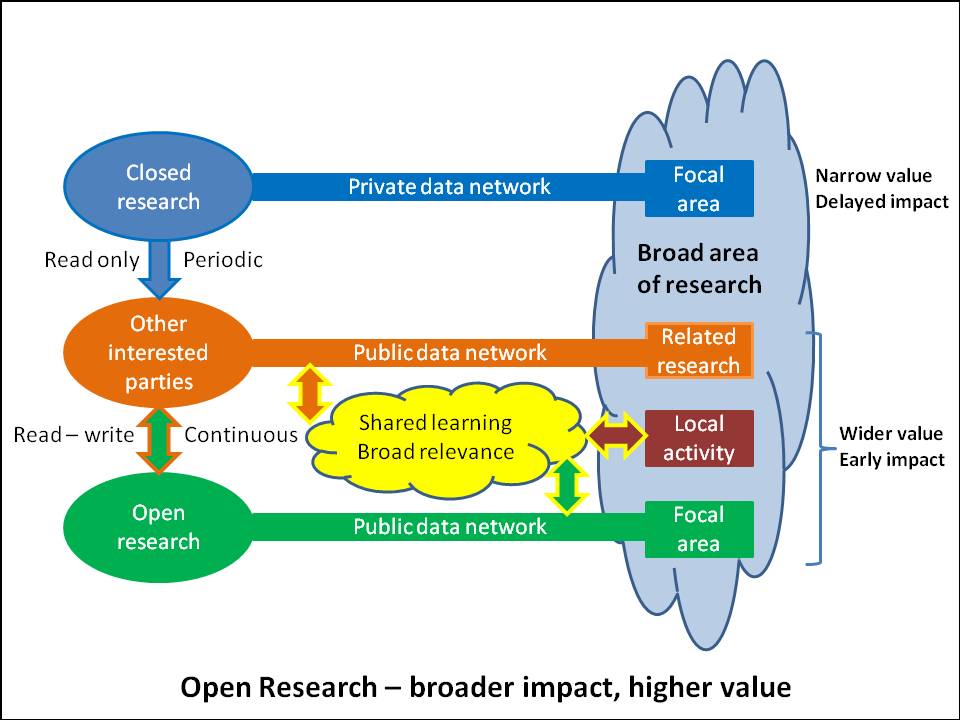
The graphic below (click on it for a larger image) tries to show how Open Research is more likely to meet my value criteria than conventional academic research.
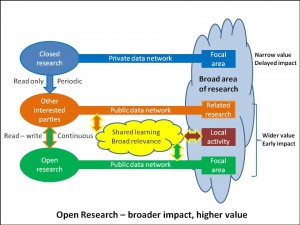
The graphic highlights that Open Research has a wider boundary and impact than just other researchers. “Open” means open to other interested parties such as NGOs, local researchers and local authorities needing guidance. This need not compromise the research – just as researchers use demographic data published by government authorities, so government authorities may use data generated by researchers in supporting their policies and financial commitments. Participation with NGOs seems a vast under-tapped source of data, because NGOs work on a scale impossible to imagine for an academic research team. I accept that many NGOs are themselves closed (and to some extent competitive) and may need lessons in the value of openness!
TESSA (Teacher Education in Sub-Saharan Africa) appears a good example of the sort of open research which adds real value. Based on open resources (OER), self-publishing (of at least some) research results, working with and through local universities, targeting localised solutions in areas of real need – all these seem to be a beacon of good practice in terms of the added value of academic research.