To clarify the starting position, my unique creations are automatically protected by copyright. So, if I want them to be more freely available, without special permission, I have to allocate a licence. Using the Creative Commons choices I have to make choices on attribution, commercial use, derivatives and share alike.
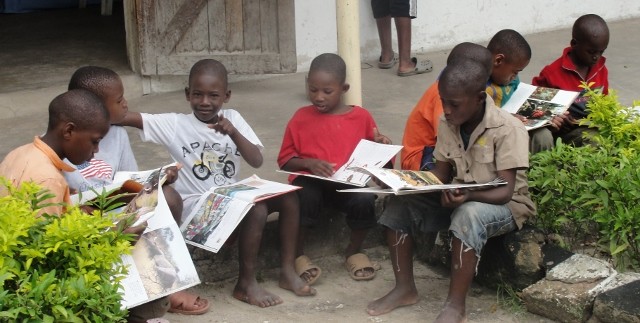
My context (for this discussion) is the support of schools in Africa with online learning materials. The ultimate objective is to improve education in Africa. So as long as this is achieved, I shouldn’t mind how. I also have to look modestly at what I am likely to be able to achieve – not a lot of absolute value, more the work required to make something available than the inherent value of the content. So it is unlikely that anyone is going to make much money from selling my materials commercially, because there will be free or better materials available Those who do make money may in fact be aiding the distribution by recovering some costs/added value of getting the material a wider audience.
Commercial use. As implied above, I am unlikely to be able to make much licence income and want to incentivise the distribution of the content. So I should allow commercial use without further permission (broadly following the arguments in Moller, 2005).
Derivatives For maximum value I should allow derivatisation. However, since this will be outside my control, I may not want attribution of the result.
Attribution. As above, I am not sure that the mix of derivatisation and attribution is attractive. However all the CC mixes assume BY unless you are going for no rights at all.
Share alike. Logically, I would want to encourage others to follow low restriction routes which are likely to enhance end user value. So share alike whould seem to make sense.
This leaves me with BY-SA, the open software or Wikipedia type of licence which sounds an attractive place to be. If it was something I treasured and felt was vulnerable to abuse via derivatisation I would probably go BY-ND (which seems to include SA by its nature).
To make life very simple, ‘no rights reserved’ would not seem an unreasonable place to be unless I felt strongly about the attribution issue.
Moller, E. (2005) The Case for Free Use: Reasons Not to Use a Creative Commons – NC License [online]. Available at http://freedomdefined.org/ Licenses/ NC (accessed 31 Mar 2013)
Pingback: CC-What? Part 2: No SA (#h817open, Activity 9) | You're the Teacher